Page Guide
Start with the short answer, then follow the mechanism
A microwave heats food by filling the oven with radio waves that transfer energy most effectively into water-rich and ion-containing parts of the food, while ordinary conduction afterward spreads some of that heat further.
These explainers turn common hardware into systems you can reason about instead of just accept as black boxes.
Interactive Explainer
How does a microwave work?
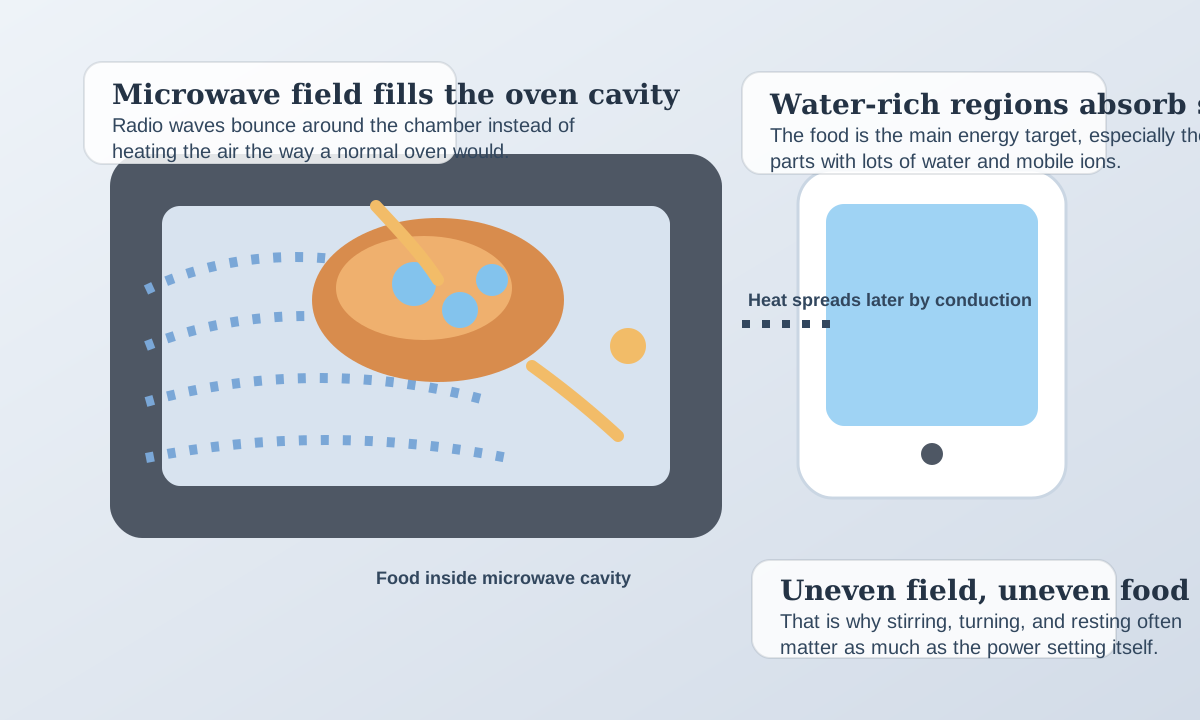
A microwave oven fills the cooking chamber with radio waves that interact strongly with polar molecules and ions inside food, especially water. Those molecules respond to the changing electromagnetic field, and the energy they absorb turns into heat. The result is often quick warming, but not always perfectly even warming.
A microwave heats food by sending radio waves into it, where water-rich parts absorb energy and warm up.
Different parts of the food absorb energy differently, and the microwave field inside the oven is not perfectly uniform.
After the microwave stops, heat continues spreading through the food by ordinary conduction, which evens out temperature differences.
Short Answer
Short answer: How does a microwave work?
A microwave heats food by filling the oven with radio waves that transfer energy most effectively into water-rich and ion-containing parts of the food, while ordinary conduction afterward spreads some of that heat further.
The sections below unpack the main mechanism, the conditions that change the answer, and the follow-up questions readers usually ask next.
Closest next questions: how does wi-fi work?, how does bluetooth work?, how do touchscreens work?
Short answer
Microwave ovens deliver energy through radio waves, not hot air or contact heating.
Why water-rich foods heat faster
Foods with more water and mobile ions usually couple more strongly to the microwave field.
Why stirring and resting matter
The microwave field is uneven, so conduction after the burst helps smooth the hot and cold spots.
Also Asked As
Other ways people ask how does a microwave work
This page is meant to catch the close variants, common misconceptions, and next-step versions of the same question without forcing readers back to search.
Closest dedicated pages: how does wi-fi work?, how does bluetooth work?, how do touchscreens work?
Choose The Closest Version
If your real question branches from here, start with the closest next page
This is the fastest way to keep the visit useful. The answer stays on-topic, and the next click stays close to what the reader actually meant.
A Wi-Fi lab that lets you change closeness, openness, channel crowding, and router quality to compare a strong connection with a frustrating weak one.
If you want the nearby-device radio version How does Bluetooth work?A Bluetooth lab that lets you change distance, interference, battery power, and antenna alignment to compare a stable link with a flaky one.
If you want the screen-sensing version of invisible signals How do touchscreens work?A touchscreen lab that lets you change contact, conductivity, moisture, and barrier thickness to compare reliable taps with missed or noisy touches.
If you want the heat-moving appliance version How does refrigeration work?A refrigeration lab that lets you change compressor strength, refrigerant flow, airflow, and door openings to compare steady cooling with a struggling overworked fridge.
Why Trust This Answer
Why trust how does a microwave work
This sits near the top on purpose so readers can see how the page was reviewed before they decide whether to keep going.
Review summary
How this page was checked
Reviewed against the listed FDA and Explain That Stuff references for microwave radiation, energy absorption, and uneven-heating explanations used on this page.
Key sources
The first places to check behind this answer
Keep The Question Moving
The next questions readers usually ask from here
This keeps the visit useful instead of one-and-done. You can branch into the next natural follow-up or open the closest dedicated explainer without losing the thread.
They move different parts of the food through different parts of the field and give heat time to redistribute.
Jump to the FAQFoods with less water often absorb microwave energy less effectively, so they may warm slowly or just dry out at the edges.
Jump to the FAQA refrigeration lab that lets you change compressor strength, refrigerant flow, airflow, and door openings to compare steady cooling with a struggling overworked fridge.
Open explainerAn egg-cooking lab that lets you change heat, cooking time, moisture, and agitation to compare silky curds with overcooked rubbery eggs.
Open explainerMyth Check
Do microwaves cook food from the inside out?
Not in the simple way that phrase suggests. Microwaves penetrate some distance into food, but the pattern still depends on water content, geometry, thickness, and how heat spreads afterward.
Penetration is real but limited
Microwave energy is not confined to the surface, yet it also does not leap instantly to the exact center of every food. The heating depth depends on the food and the oven setup.
Resting and stirring are part of the process
Much of the evening-out happens after the magnetron stops, when hot regions share energy with cooler ones through ordinary conduction and mixing.
Try It Yourself
Microwave Heating Lab
Raise the power, add water, make the food thicker, or stir and rest between bursts to see when the heating becomes efficient and when hot spots take over.
Move the controls or load a preset to see how the system responds.
What changes the fastest
What is driving the result
The Big Idea
How does a microwave work
Learn how microwave ovens transfer energy into food, why water-rich foods heat quickly, and why hot spots and cold centers happen.
The oven produces microwave radiation
That radiation is a form of electromagnetic wave, not a shower of tiny hot particles.
The field couples strongly to parts of the food
Water-rich and ion-containing regions respond well to the oscillating field and absorb energy.
Absorbed energy becomes heat inside the food
The excited molecules jostle and transfer energy to neighboring molecules, warming the material.
Heat keeps spreading after the microwave stops
Ordinary conduction smooths some of the temperature differences, which is why stirring or resting often improves the final result.
Follow-Up Answer
Why do microwaved foods get hot spots and cold centers?
The field inside the oven is not perfectly uniform, and foods are not uniform targets either.
Standing-wave patterns create stronger and weaker zones
Different parts of the cavity can receive different amounts of microwave intensity, which is why turntables and repositioning help expose the food to a broader mix of the field.
Composition and thickness change the outcome
A thick lasagna, a dry crust, and a watery sauce do not absorb energy the same way, so one uninterrupted heating burst often creates edges and pockets that race ahead of the center.
Good Follow-Up Questions
How does a microwave work: edge cases and follow-up questions
The short answer helps, but the edge cases, tradeoffs, and scene changes are what usually make the topic memorable.
Microwaves do not always cook “from the inside out”
They penetrate some distance into food, but the exact heating pattern depends on the food and the oven rather than following one simple rule.
Metal does not heat the same way as water-rich food
Metals tend to reflect microwaves and can create arcing problems, especially when edges are sharp.
Resting is part of the cooking process
When you pause and let heat redistribute, the overall temperature becomes more even than it looked at the instant the microwave beeped.
Compare Scenes
Microwave results depend heavily on what kind of food is inside and how you manage the heating
Water content, thickness, and whether you pause to stir or rest matter almost as much as the power setting itself.
Water-rich and easy to redistribute
A bowl of soup
Soups absorb microwave energy well, and stirring quickly evens out temperature differences.
Soup
A bowl of soup
Soups absorb microwave energy well, and stirring quickly evens out temperature differences.
Thick leftovers
A thick container of leftovers
The outside may heat fast while deeper regions lag, so one uninterrupted blast often creates hot edges and cool centers.
Dry food
A relatively dry snack
With less water available to absorb energy, the heating is weaker and drying can become more noticeable than warming.
Fast Answers
How does a microwave work? FAQ
Good science pages should answer the obvious follow-ups without making the reader hunt for them.
If your real question is closer to how does wi-fi work?, that page covers the narrower version directly.
If your real question is closer to how does bluetooth work?, that page covers the narrower version directly.
If your real question is closer to how do touchscreens work?, that page covers the narrower version directly.
If your real question is closer to how does refrigeration work?, that page covers the narrower version directly.
Trust And Further Reading
Sources and review notes for how does a microwave work
Reviewed against the listed FDA and Explain That Stuff references for microwave radiation, energy absorption, and uneven-heating explanations used on this page. This page also links outward to trusted references and inward to nearby explainers on the same topic path.
Editorial review
How this page was reviewed
Reviewed against the listed FDA and Explain That Stuff references for microwave radiation, energy absorption, and uneven-heating explanations used on this page.
Further reading
Trusted places to continue learning
Stay In This Topic
More from Everyday Engineering
Signals, circuits, refrigeration, and other engineering ideas hiding in ordinary tools and devices.
A Wi-Fi lab that lets you change closeness, openness, channel crowding, and router quality to compare a strong connection with a frustrating weak one.
Everyday Engineering How do touchscreens work?A touchscreen lab that lets you change contact, conductivity, moisture, and barrier thickness to compare reliable taps with missed or noisy touches.
Everyday Engineering How do GPS satellites work?A GPS lab that lets you change satellite view, timing quality, sky openness, and reflections to compare an accurate fix with an error-prone one.
Everyday Engineering How do microphones work?A microphone lab that lets you change sound level, diaphragm response, magnet strength, and background noise to compare clean voice capture with noisy or overloaded audio.
Related Public Questions
Questions people on the site are also asking
This keeps the explainer connected to the rest of the archive instead of feeling like an isolated page.
No close public question matches are cached yet, but the search page is a good next stop if you want to explore the archive from this starting point.