Page Guide
Start with the short answer, then follow the mechanism
GPS works by comparing the arrival times of radio signals from several satellites with known positions, then solving for the receiver's location and clock error from those timing differences.
These explainers turn common hardware into systems you can reason about instead of just accept as black boxes.
Interactive Explainer
How do GPS satellites work?
GPS satellites continuously transmit signals that include very accurate timing information and details about where the satellite is in orbit. A receiver on Earth compares the arrival times from several satellites, works out how far away each one seems to be, and solves for its own position and clock correction from that geometry.
GPS works by measuring how long radio signals from several satellites take to reach your receiver and using that timing to solve for position.
Because radio waves move at the speed of light, even tiny timing errors can become large position errors.
The more clearly your receiver can hear multiple satellites from different directions, the stronger and more accurate the position solution becomes.
Short Answer
Short answer: How do GPS satellites work?
GPS works by comparing the arrival times of radio signals from several satellites with known positions, then solving for the receiver's location and clock error from those timing differences.
The sections below unpack the main mechanism, the conditions that change the answer, and the follow-up questions readers usually ask next.
Closest next questions: how does wi-fi work?, how does bluetooth work?, how do touchscreens work?
Short answer
GPS is mostly a timing measurement problem that turns into a geometry solution.
Why four or more signals matter
The receiver must solve for position and fix its own imperfect clock at the same time.
Why open sky helps
More clean satellite paths from more directions make the solution tighter and more stable.
Also Asked As
Other ways people ask how do gps satellites work
This page is meant to catch the close variants, common misconceptions, and next-step versions of the same question without forcing readers back to search.
Closest dedicated pages: how does wi-fi work?, how does bluetooth work?, how do touchscreens work?
Choose The Closest Version
If your real question branches from here, start with the closest next page
This is the fastest way to keep the visit useful. The answer stays on-topic, and the next click stays close to what the reader actually meant.
A Wi-Fi lab that lets you change closeness, openness, channel crowding, and router quality to compare a strong connection with a frustrating weak one.
If you want the nearby-device radio version How does Bluetooth work?A Bluetooth lab that lets you change distance, interference, battery power, and antenna alignment to compare a stable link with a flaky one.
If you want the screen-sensing version of invisible signals How do touchscreens work?A touchscreen lab that lets you change contact, conductivity, moisture, and barrier thickness to compare reliable taps with missed or noisy touches.
If you want radio waves heating food instead of carrying data How does a microwave work?A microwave lab that lets you change power, water content, thickness, and stirring or resting to compare even heating with frustrating cold centers and hot edges.
Why Trust This Answer
Why trust how do gps satellites work
This sits near the top on purpose so readers can see how the page was reviewed before they decide whether to keep going.
Review summary
How this page was checked
Reviewed against the listed GPS.gov references for trilateration, timing-based positioning, and everyday accuracy limits described on this page.
Key sources
The first places to check behind this answer
Keep The Question Moving
The next questions readers usually ask from here
This keeps the visit useful instead of one-and-done. You can branch into the next natural follow-up or open the closest dedicated explainer without losing the thread.
The receiver can hear more satellites from more directions with fewer obstructions and reflections.
Jump to the FAQSeveral are needed for a full position and clock solution, and more good satellites generally improve robustness.
Jump to the FAQA compass lab that lets you tune field strength, interference, latitude, and needle friction to see when the needle locks on and when it starts lying to you.
Open explainerA Wi-Fi lab that lets you change closeness, openness, channel crowding, and router quality to compare a strong connection with a frustrating weak one.
Open explainerMyth Check
Do GPS satellites tell your phone where you are?
No. The satellites mostly broadcast timing and orbit information. Your receiver does the hard work of computing the location.
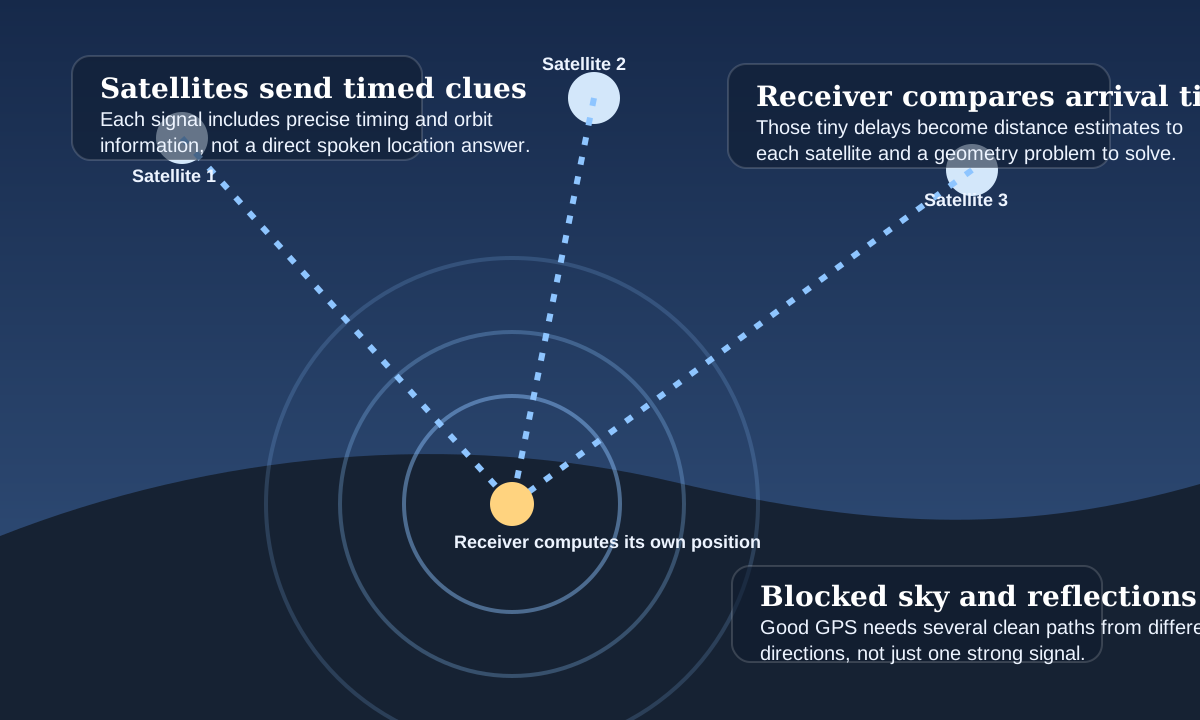
The receiver measures delay, not a spoken answer
Your device estimates how far away each satellite seems by comparing when the signal was sent with when it arrived, then combines several of those ranges at once.
The clock correction is part of the solution
Because the receiver's own clock is not as perfect as the satellites' clocks, it has to solve for time bias and position together rather than treating its clock as already correct.
Try It Yourself
GPS Positioning Lab
Give the receiver more satellites, cleaner timing, a more open sky, or fewer reflections to see when the position fix tightens up.
Move the controls or load a preset to see how the system responds.
What changes the fastest
What is driving the result
The Big Idea
How do GPS satellites work
Learn how GPS satellites use timing signals to locate you, why several satellites are needed, and why buildings and reflections hurt accuracy.
Satellites broadcast time-tagged signals
Each GPS satellite sends data that tells receivers when the signal left and where the satellite is supposed to be.
The receiver measures signal travel time
By comparing arrival times from multiple satellites, the receiver estimates distances to those satellites.
Several distance measurements are combined
The receiver solves a geometry problem using multiple satellite ranges at once rather than depending on just one signal.
Errors are reduced but never fully absent
Clock imperfections, atmospheric effects, blocked sky, and reflected paths all influence how accurate the solution can be.
Follow-Up Answer
Why do cities, tree cover, and reflections degrade GPS?
The receiver wants clean paths from many directions, and cluttered environments take those conditions away.
Blocked sky means weaker geometry
When buildings or terrain hide part of the sky, the receiver hears fewer satellites and often hears them from less helpful directions, which loosens the location solution.
Reflections create fake longer paths
A bounced signal arrives late, making the satellite seem farther away than it really is. That is why urban canyons can produce wandering position fixes even when GPS still appears to work.
Good Follow-Up Questions
How do GPS satellites work: edge cases and follow-up questions
The short answer helps, but the edge cases, tradeoffs, and scene changes are what usually make the topic memorable.
GPS accuracy is partly about satellite geometry
Signals arriving from well-spread directions constrain your position better than signals clustered in one part of the sky.
Tall buildings can create misleading paths
A reflected signal takes longer to arrive and can trick the receiver into thinking the satellite is farther away than it really is.
Your receiver solves for time and position together
Because its internal clock is not as perfect as the satellite clocks, it has to correct its own timing while solving the location.
Compare Scenes
GPS feels excellent in open sky and far shakier when the radio path gets messy
Coverage, geometry, timing quality, and reflections decide whether the position fix is tight or sloppy.
The best-case environment
A receiver in open sky
Many satellites are visible, the paths are clean, and the geometry is strong enough for a solid position fix.
Open field
A receiver in open sky
Many satellites are visible, the paths are clean, and the geometry is strong enough for a solid position fix.
Urban canyon
A downtown street between tall buildings
The receiver has fewer clean satellite paths and more reflections, so the location can jump or wander.
Forest trail
A receiver under partial tree cover
The fix may still work, but some signals are weakened or blocked enough that performance is less consistent than in open terrain.
Fast Answers
How do GPS satellites work? FAQ
Good science pages should answer the obvious follow-ups without making the reader hunt for them.
If your real question is closer to how does wi-fi work?, that page covers the narrower version directly.
If your real question is closer to how does bluetooth work?, that page covers the narrower version directly.
If your real question is closer to how do touchscreens work?, that page covers the narrower version directly.
If your real question is closer to how does a microwave work?, that page covers the narrower version directly.
Trust And Further Reading
Sources and review notes for how do gps satellites work
Reviewed against the listed GPS.gov references for trilateration, timing-based positioning, and everyday accuracy limits described on this page. This page also links outward to trusted references and inward to nearby explainers on the same topic path.
Editorial review
How this page was reviewed
Reviewed against the listed GPS.gov references for trilateration, timing-based positioning, and everyday accuracy limits described on this page.
Further reading
Trusted places to continue learning
Stay In This Topic
More from Everyday Engineering
Signals, circuits, refrigeration, and other engineering ideas hiding in ordinary tools and devices.
A touchscreen lab that lets you change contact, conductivity, moisture, and barrier thickness to compare reliable taps with missed or noisy touches.
Everyday Engineering How does Wi-Fi work?A Wi-Fi lab that lets you change closeness, openness, channel crowding, and router quality to compare a strong connection with a frustrating weak one.
Everyday Engineering How does a microwave work?A microwave lab that lets you change power, water content, thickness, and stirring or resting to compare even heating with frustrating cold centers and hot edges.
Everyday Engineering How do microphones work?A microphone lab that lets you change sound level, diaphragm response, magnet strength, and background noise to compare clean voice capture with noisy or overloaded audio.
Related Public Questions
Questions people on the site are also asking
This keeps the explainer connected to the rest of the archive instead of feeling like an isolated page.
No close public question matches are cached yet, but the search page is a good next stop if you want to explore the archive from this starting point.