Page Guide
Start with the short answer, then follow the mechanism
A mirror does not truly swap left and right. It reverses the front-back direction relative to the mirror, and our brains translate that geometry into a left-right feeling when we imagine another person turned around to face us.
These topics reward attention because they make ordinary skies, mirrors, and reflections feel far stranger and more precise.
Interactive Explainer
Why do mirrors reverse left and right?
A mirror does not really swap your left and right sides. It reverses the direction perpendicular to the mirror, which is better described as front and back. The left-right confusion appears because we imagine how another person would have to rotate to face us and then compare that imagined person to the reflection.
A mirror flips front and back, not left and right. The left-right feeling comes from how our brains compare the reflection to a turned-around person.
Printed text is designed for a viewer on the same side as the page. Mirror reflection flips the depth orientation, which makes the letter order look reversed to us.
Human faces are roughly symmetrical, so your brain often accepts the reflection easily until an asymmetric cue like a watch or printed word makes the inversion obvious.
Short Answer
Short answer: Why do mirrors reverse left and right?
A mirror does not truly swap left and right. It reverses the front-back direction relative to the mirror, and our brains translate that geometry into a left-right feeling when we imagine another person turned around to face us.
The sections below unpack the main mechanism, the conditions that change the answer, and the follow-up questions readers usually ask next.
Closest next questions: why is the sky blue?, why are sunsets red?, how do rainbows form?
Short answer
Mirrors flip front and back, not left and right. The left-right feeling comes from human interpretation.
Why text looks reversed
Words are strongly directional, so the front-back inversion becomes obvious immediately.
Why faces feel normal
Faces are roughly symmetrical, so your brain often accepts the reflection until an asymmetric cue exposes the trick.
Also Asked As
Other ways people ask why do mirrors reverse left and right
This page is meant to catch the close variants, common misconceptions, and next-step versions of the same question without forcing readers back to search.
Closest dedicated pages: why is the sky blue?, why are sunsets red?, how do rainbows form?
Choose The Closest Version
If your real question branches from here, start with the closest next page
This is the fastest way to keep the visit useful. The answer stays on-topic, and the next click stays close to what the reader actually meant.
A live sky simulator, a clear explanation of Rayleigh scattering, and a comparison with the Moon and Mars.
If your real question is about red sunsets and warm horizons Why are sunsets red?A sunset lab that lets you change Sun angle, air clarity, particles, and cloud glow to compare pale gold skies with deep fiery reds.
If you want geometry and color separation in motion How do rainbows form?A rainbow lab that lets you move the Sun, change the spray, and darken the storm background to see when an arc strengthens or disappears.
If you mean why do mirages happen? Why do mirages happen?A mirage lab that lets you vary ground heating, viewing distance, air layering, and surface brightness to see when a false pool of water or lifted image appears.
Why Trust This Answer
Why trust why do mirrors reverse left and right
This sits near the top on purpose so readers can see how the page was reviewed before they decide whether to keep going.
Review summary
How this page was checked
Reviewed against the listed PBS and Wired explainers for the front-back inversion and perception claims used on this page.
Key sources
The first places to check behind this answer
Keep The Question Moving
The next questions readers usually ask from here
This keeps the visit useful instead of one-and-done. You can branch into the next natural follow-up or open the closest dedicated explainer without losing the thread.
Because your face is fairly symmetrical, so your brain accepts the reflected version easily until an asymmetric clue draws attention to the inversion.
Jump to the FAQA mirror simply reverses front and back relative to its own surface. The up-down or left-right feeling depends on how you orient yourself to it.
Jump to the FAQA mirage lab that lets you vary ground heating, viewing distance, air layering, and surface brightness to see when a false pool of water or lifted image appears.
Open explainerA rainbow lab that lets you move the Sun, change the spray, and darken the storm background to see when an arc strengthens or disappears.
Open explainerMyth Check
Do mirrors really swap left and right?
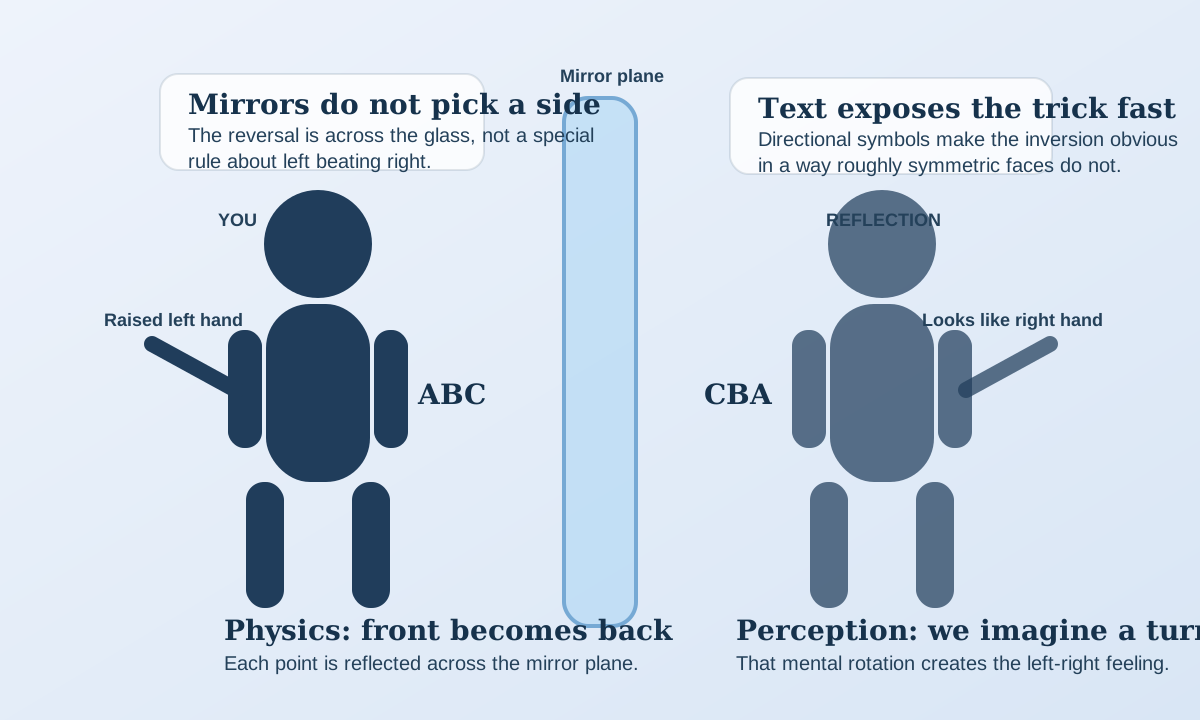
Not in the optics. The mirror only reverses the direction pointing into it and out of it. The left-right interpretation gets added by us.
The physics is simple
Every point in the reflection is mirrored across the plane of the glass. Nothing in the law of reflection says horizontal directions should get special treatment.
The brain adds the confusion
We compare the reflection to a human body facing us, which requires an imagined turn. That mental rotation is what makes the image feel left-right reversed.
Try It Yourself
Mirror Perception Lab
Rotate the viewer, tilt the mirror, strengthen asymmetry cues, or add bold text to see when the reflection feels natural and when the inversion becomes impossible to ignore.
Move the controls or load a preset to see how the system responds.
What changes the fastest
What is driving the result
The Big Idea
Why do mirrors reverse left and right
Learn why mirrors really flip front and back, why text looks reversed, and why faces still feel normal. Interactive lab, diagram, and FAQs.
The mirror reflects depth, not handedness
Points closer to the mirror and farther from the mirror trade places in the reflected geometry. That is the true physical inversion.
Your brain compares the image to a person facing you
To imagine another person standing where the reflection is, we mentally rotate a human body around, and that mental step introduces left-right language.
Symmetry hides the trick for a while
Faces, torsos, and simple poses are similar enough on both sides that the reflection feels ordinary unless you look for an uneven detail.
Text and one-sided objects expose the inversion
A watch on one wrist, a raised right hand, or printed words make it much easier to notice what has happened.
Follow-Up Answer
Why does text look backward in a mirror while your face still looks normal?
Asymmetry is what exposes the inversion, and text is one of the strongest asymmetry cues we ever look at.
Text is brutally directional
Letter order and letter shape depend on orientation, so even a small reversal becomes obvious immediately when you look at a reflected word.
Faces hide the trick
Human faces are similar enough on both sides that the reflection feels ordinary until a watch, raised hand, or printed shirt gives your brain a stronger one-sided clue.
Good Follow-Up Questions
Why do mirrors reverse left and right: edge cases and follow-up questions
The short answer helps, but the edge cases, tradeoffs, and scene changes are what usually make the topic memorable.
Mirrors do not privilege horizontal over vertical
A mirror will just as happily invert front and back for a floor-ceiling arrangement. The special left-right feeling comes from how humans are oriented, not from mirror physics itself.
Text feels especially wrong because order matters
Letter sequences and directional symbols depend strongly on orientation, so the inversion becomes striking immediately.
Angled mirrors add another layer of confusion
Once the mirror is tilted, the reflected geometry no longer lines up with a simple face-to-face interpretation, so the scene feels even stranger.
Compare Scenes
Why your face looks normal but your T-shirt slogan instantly looks backwards
The more asymmetry and directional information the scene contains, the harder it is for your brain to ignore the underlying inversion.
Symmetry hides the trick
Looking at your own face
Because human faces are roughly symmetrical, your reflection often feels perfectly normal until a stronger directional cue appears.
Plain face
Looking at your own face
Because human faces are roughly symmetrical, your reflection often feels perfectly normal until a stronger directional cue appears.
Raised hand
Watch or raised-hand cue
A clearly one-sided object makes it easier to notice that the reflection is not just another person standing there unchanged.
Printed shirt
Words in the mirror
Text carries strong directional structure, so mirror inversion is immediately obvious when you read a reflected word or number.
Angled
Angled mirror view
Tilt the mirror and the reflection stops matching the simple face-to-face story, making the geometry feel more unfamiliar and harder to narrate.
Fast Answers
Why do mirrors reverse left and right? FAQ
Good science pages should answer the obvious follow-ups without making the reader hunt for them.
If your real question is closer to why is the sky blue?, that page covers the narrower version directly.
If your real question is closer to why are sunsets red?, that page covers the narrower version directly.
If your real question is closer to how do rainbows form?, that page covers the narrower version directly.
If your real question is closer to why do mirages happen?, that page covers the narrower version directly.
Trust And Further Reading
Sources and review notes for why do mirrors reverse left and right
Reviewed against the listed PBS and Wired explainers for the front-back inversion and perception claims used on this page. This page also links outward to trusted references and inward to nearby explainers on the same topic path.
Editorial review
How this page was reviewed
Reviewed against the listed PBS and Wired explainers for the front-back inversion and perception claims used on this page.
Further reading
Trusted places to continue learning
Stay In This Topic
More from Light and Color
Scattering, reflection, mirages, and visual tricks that change what we think we are seeing.
A mirage lab that lets you vary ground heating, viewing distance, air layering, and surface brightness to see when a false pool of water or lifted image appears.
Light and Color Why is snow white?A snow optics lab that lets you change grain freshness, packing, meltwater, and soot to see when snow glows bright white and when it turns gray or dingy.
Light and Color Why do stars twinkle?A twinkle lab that lets you change turbulence, altitude, humidity, and apparent size to compare stars with steadier-looking planets.
Light and Color How do rainbows form?A rainbow lab that lets you move the Sun, change the spray, and darken the storm background to see when an arc strengthens or disappears.
Related Public Questions
Questions people on the site are also asking
This keeps the explainer connected to the rest of the archive instead of feeling like an isolated page.
No close public question matches are cached yet, but the search page is a good next stop if you want to explore the archive from this starting point.