Page Guide
Start with the short answer, then follow the mechanism
Sunsets look red because low-angle sunlight crosses a much longer path through the atmosphere, so more blue light is scattered away before the direct beam reaches your eyes.
These topics reward attention because they make ordinary skies, mirrors, and reflections feel far stranger and more precise.
Interactive Explainer
Why are sunsets red?
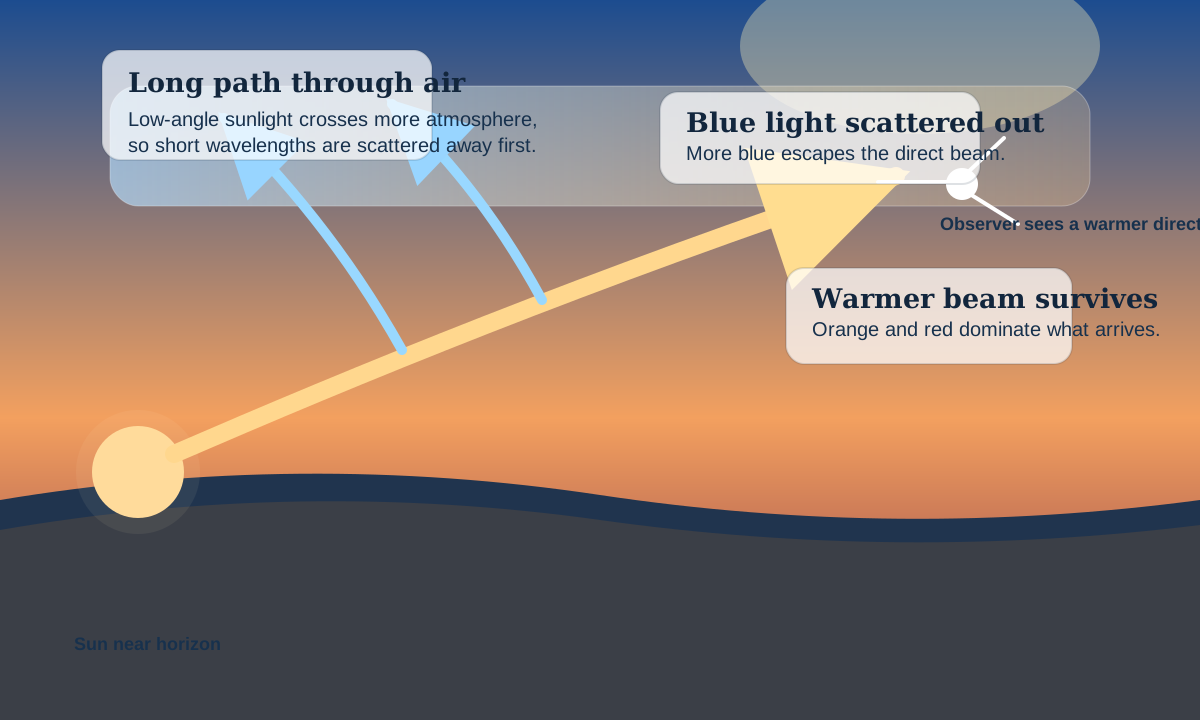
At sunset, sunlight has to travel through much more atmosphere before reaching your eyes. Along that longer path, shorter blue wavelengths get scattered out of the direct beam more efficiently, so the remaining sunlight looks richer in red, orange, and gold.
Sunsets look red because low-angle sunlight travels through more air, which strips more blue light out of the direct beam before it reaches you.
Dust, smoke, and pollution can make warm colors more dramatic, but too much can also wash the whole scene out.
Color depends on both filtering and contrast, so clouds, humidity, and particle size can turn a vivid sunset into a pale one.
Short Answer
Short answer: Why are sunsets red?
Sunsets look red because low-angle sunlight crosses a much longer path through the atmosphere, so more blue light is scattered away before the direct beam reaches your eyes.
The sections below unpack the main mechanism, the conditions that change the answer, and the follow-up questions readers usually ask next.
Closest next questions: why is the sky blue?, how do rainbows form?, why do fireworks have colors?
Short answer
Long atmospheric paths strip more blue and green from the direct beam, leaving warmer colors behind.
Why haze matters
A modest amount of dust or smoke can intensify warm colors, but heavy haze can also flatten the whole scene.
Why sunrise matches
Sunrise uses the same geometry and scattering physics, just with different local air and cloud conditions.
Also Asked As
Other ways people ask why are sunsets red
This page is meant to catch the close variants, common misconceptions, and next-step versions of the same question without forcing readers back to search.
Closest dedicated pages: why is the sky blue?, how do rainbows form?, why do fireworks have colors?
Choose The Closest Version
If your real question branches from here, start with the closest next page
This is the fastest way to keep the visit useful. The answer stays on-topic, and the next click stays close to what the reader actually meant.
A live sky simulator, a clear explanation of Rayleigh scattering, and a comparison with the Moon and Mars.
If you want geometry and color separation in motion How do rainbows form?A rainbow lab that lets you move the Sun, change the spray, and darken the storm background to see when an arc strengthens or disappears.
If you mean why do fireworks have colors? Why do fireworks have colors?A fireworks lab that lets you change flame heat, metal-salt mix, oxygen feed, and burst spread to compare deep reds, bright greens, and washed-out sparks.
If you mean why is glass transparent? Why is glass transparent?A glass lab that lets you change thickness, purity, smoothness, and tint to compare a clear window with frosted or bottle glass.
Why Trust This Answer
Why trust why are sunsets red
This sits near the top on purpose so readers can see how the page was reviewed before they decide whether to keep going.
Review summary
How this page was checked
Reviewed against the listed NASA and National Weather Service explainers for the long-path scattering and haze effects described on this page.
Key sources
The first places to check behind this answer
Keep The Question Moving
The next questions readers usually ask from here
This keeps the visit useful instead of one-and-done. You can branch into the next natural follow-up or open the closest dedicated explainer without losing the thread.
They can intensify warm colors by adding more particles, but heavy smoke can also flatten the view and reduce overall visibility.
Jump to the FAQYes. Sunrise and sunset both involve low-angle sunlight traveling through a longer stretch of atmosphere.
Jump to the FAQA live sky simulator, a clear explanation of Rayleigh scattering, and a comparison with the Moon and Mars.
Open explainerA rainbow lab that lets you move the Sun, change the spray, and darken the storm background to see when an arc strengthens or disappears.
Open explainerMyth Check
Are sunsets red only because the air is dirty?
No. Clean air already makes sunsets warm because the sunlight is taking a much longer path through the atmosphere than it does at noon.
Clean air still works
Even an exceptionally clear atmosphere can produce orange and red sunsets because path length alone changes how much blue light is removed before the beam reaches you.
Particles change the drama
Dust, smoke, and aerosols can deepen the effect or wash it out. They change the intensity and contrast of the sunset more than they create the basic color from nothing.
Try It Yourself
Sunset Color Lab
Lower the Sun, add haze, or brighten the cloud layer to see when a sunset turns richly red and when it fades into a flatter glow.
Move the controls or load a preset to see how the system responds.
What changes the fastest
What is driving the result
The Big Idea
Why are sunsets red
Learn why sunsets turn red, orange, and pink, why haze can intensify or mute them, and why sunrise uses the same physics. Interactive lab, diagram, and FAQs.
Sunlight begins as a broad mix of visible colors
White sunlight contains many wavelengths, including blue, green, yellow, orange, and red light.
A low Sun sends that light through more atmosphere
Near the horizon, the direct beam takes a longer path through air than it does at midday.
Shorter wavelengths get scattered away more strongly
Blue light is scattered out of the direct line of sight more efficiently, leaving the beam that reaches you comparatively warmer.
Particles and clouds reshape the final palette
Dust, smoke, humidity, and cloud layers can deepen reds, brighten oranges, or soften contrast depending on how they interact with the filtered sunlight.
Follow-Up Answer
Why do clouds glow orange, pink, and purple at sunset?
Clouds do not make their own sunset colors. They intercept the already-filtered sunlight that is left late in the day.
High clouds catch the warm beam first
Clouds still in sunlight after the ground is dimming can light up dramatically because they are catching the warm beam while the lower atmosphere is already in shadow.
The color depends on what survives the path
If the direct sunlight has already lost a lot of blue and green, the clouds it hits can glow gold, orange, pink, or red instead of plain white.
Good Follow-Up Questions
Why are sunsets red: edge cases and follow-up questions
The short answer helps, but the edge cases, tradeoffs, and scene changes are what usually make the topic memorable.
Sunset color is about the direct beam, not just the whole sky
The dramatic warm tones come from what remains in the sunlight traveling straight from the low Sun toward your eyes.
More particles do not guarantee a better sunset
A modest amount can intensify warm colors, but too much haze can blur the scene and reduce the clean contrast that makes a sunset look vivid.
Sunrise uses the same physics
Sunrises can be just as red because the geometry is the same, although the local air and cloud conditions are often different.
Compare Scenes
The same low Sun can produce very different sunsets
The main differences come from how much blue light gets removed and how much contrast survives the trip through the air.
Warm but crisp
A clear dry sunset
The long path removes plenty of blue light while the relatively clean air preserves contrast, giving a bright gold-to-red horizon.
Clear
A clear dry sunset
The long path removes plenty of blue light while the relatively clean air preserves contrast, giving a bright gold-to-red horizon.
Dusty
A dusty or smoky evening
Extra particles remove and redirect more short-wavelength light, which can make reds and oranges look richer if the scene does not become too murky.
Washed
A sunset lost in thick haze
The air still filters colors, but heavy haze reduces clarity enough that the scene can feel pale or muted rather than dramatic.
Fast Answers
Why are sunsets red? FAQ
Good science pages should answer the obvious follow-ups without making the reader hunt for them.
If your real question is closer to why is the sky blue?, that page covers the narrower version directly.
If your real question is closer to how do rainbows form?, that page covers the narrower version directly.
If your real question is closer to why do fireworks have colors?, that page covers the narrower version directly.
If your real question is closer to why is glass transparent?, that page covers the narrower version directly.
Trust And Further Reading
Sources and review notes for why are sunsets red
Reviewed against the listed NASA and National Weather Service explainers for the long-path scattering and haze effects described on this page. This page also links outward to trusted references and inward to nearby explainers on the same topic path.
Editorial review
How this page was reviewed
Reviewed against the listed NASA and National Weather Service explainers for the long-path scattering and haze effects described on this page.
Further reading
Trusted places to continue learning
Stay In This Topic
More from Light and Color
Scattering, reflection, mirages, and visual tricks that change what we think we are seeing.
A glass lab that lets you change thickness, purity, smoothness, and tint to compare a clear window with frosted or bottle glass.
Light and Color Why is snow white?A snow optics lab that lets you change grain freshness, packing, meltwater, and soot to see when snow glows bright white and when it turns gray or dingy.
Light and Color Why do mirrors reverse left and right?A mirror-perception lab that lets you vary body rotation, mirror angle, asymmetry cues, and text clues to see when the reflection feels intuitive and when it feels backwards.
Light and Color Why do mirages happen?A mirage lab that lets you vary ground heating, viewing distance, air layering, and surface brightness to see when a false pool of water or lifted image appears.
Related Public Questions
Questions people on the site are also asking
This keeps the explainer connected to the rest of the archive instead of feeling like an isolated page.
No close public question matches are cached yet, but the search page is a good next stop if you want to explore the archive from this starting point.