Page Guide
Start with the short answer, then follow the mechanism
Rainbows form when sunlight enters raindrops, bends, reflects inside them, and exits at angles that separate the colors so different droplets send different wavelengths toward your eyes.
These topics reward attention because they make ordinary skies, mirrors, and reflections feel far stranger and more precise.
Interactive Explainer
How do rainbows form?
A rainbow appears when sunlight enters many raindrops, bends, reflects inside, and emerges separated into colors. You only see it when the geometry is right: Sun behind you, droplets ahead of you, and the Sun not too high.
Rainbows are made by refraction, internal reflection, and dispersion inside countless droplets, not by colors being painted onto the sky.
Low Sun, bright droplets, and a darker background often make the arc appear stronger and easier to notice.
Red appears on the outer edge of a primary rainbow and violet on the inner edge because different wavelengths leave the drop at slightly different angles.
Short Answer
Short answer: How do rainbows form?
Rainbows form when sunlight enters raindrops, bends, reflects inside them, and exits at angles that separate the colors so different droplets send different wavelengths toward your eyes.
The sections below unpack the main mechanism, the conditions that change the answer, and the follow-up questions readers usually ask next.
Closest next questions: why is the sky blue?, why are sunsets red?, why do stars twinkle?
Short answer
Rainbows come from refraction, internal reflection, and dispersion inside many droplets.
Why geometry matters
You need the Sun behind you, droplets ahead, and the right angle between them for the bow to appear.
Why second bows flip colors
An extra internal reflection changes both the brightness and the order of the emerging colors.
Also Asked As
Other ways people ask how do rainbows form
This page is meant to catch the close variants, common misconceptions, and next-step versions of the same question without forcing readers back to search.
Closest dedicated pages: why is the sky blue?, why are sunsets red?, why do stars twinkle?
Choose The Closest Version
If your real question branches from here, start with the closest next page
This is the fastest way to keep the visit useful. The answer stays on-topic, and the next click stays close to what the reader actually meant.
A live sky simulator, a clear explanation of Rayleigh scattering, and a comparison with the Moon and Mars.
If your real question is about red sunsets and warm horizons Why are sunsets red?A sunset lab that lets you change Sun angle, air clarity, particles, and cloud glow to compare pale gold skies with deep fiery reds.
If you mean why do stars twinkle? Why do stars twinkle?A twinkle lab that lets you change turbulence, altitude, humidity, and apparent size to compare stars with steadier-looking planets.
If you mean why do we have seasons? Why do we have seasons?A season lab that lets you change Earth’s tilt, latitude, and orbital position to see how sunlight and daylight shift.
Why Trust This Answer
Why trust how do rainbows form
This sits near the top on purpose so readers can see how the page was reviewed before they decide whether to keep going.
Review summary
How this page was checked
Reviewed against the listed National Weather Service and UCAR educational references for the droplet geometry, color separation, and secondary-rainbow explanations on this page.
Key sources
The first places to check behind this answer
Keep The Question Moving
The next questions readers usually ask from here
This keeps the visit useful instead of one-and-done. You can branch into the next natural follow-up or open the closest dedicated explainer without losing the thread.
The extra internal reflection loses light, so the secondary bow is usually fainter.
Jump to the FAQThey see the same pattern in the sky, but each person is receiving light from a slightly different set of droplets.
Jump to the FAQA live sky simulator, a clear explanation of Rayleigh scattering, and a comparison with the Moon and Mars.
Open explainerA twinkle lab that lets you change turbulence, altitude, humidity, and apparent size to compare stars with steadier-looking planets.
Open explainerMyth Check
Is a rainbow in one fixed place in the sky?
Not really. The bow depends on the line between you, the Sun, and the droplets, so when you move, you are effectively seeing a different set of droplets build the rainbow.
The bow is observer-centered
The rainbow is built from whichever droplets are sending the right angles toward your eyes. Someone standing elsewhere is seeing a slightly different rainbow assembled from other droplets.
That is why you never arrive at the end
Walk toward a rainbow and the geometry just rebuilds farther away. The bow is not a painted object hanging in one place that you can physically reach.
Try It Yourself
Rainbow Lab
Lower the Sun, thicken the spray, enlarge the droplets, or darken the cloud background to see when a rainbow sharpens, widens, or disappears entirely.
Move the controls or load a preset to see how the system responds.
What changes the fastest
What is driving the result
The Big Idea
How do rainbows form
Learn how raindrops bend and separate sunlight, why rainbow colors stay in order, and why a second rainbow reverses them. Interactive lab, diagram, and FAQs.
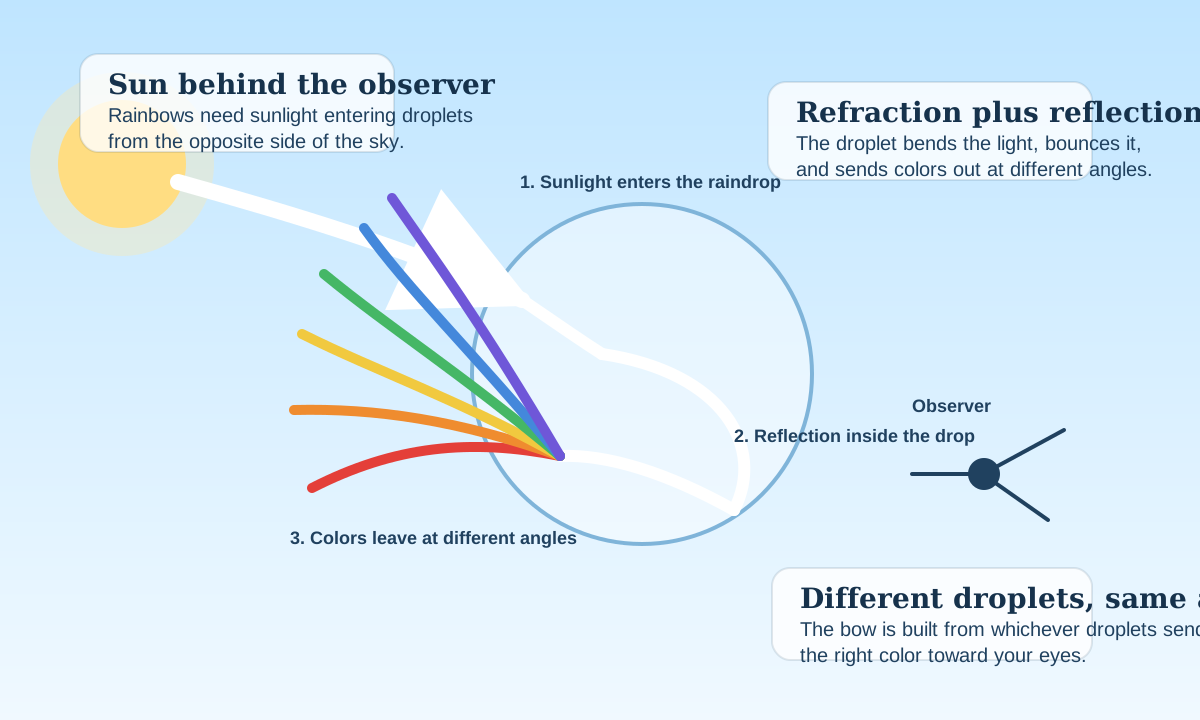
Sunlight enters the droplet
As the light crosses from air into water, it bends because it is moving into a different medium.
Colors spread slightly apart
Different wavelengths bend by slightly different amounts, so white sunlight begins to separate into a spectrum.
Light reflects inside the drop
Some of the light bounces off the back of the droplet and heads back toward the front.
Only the right exit angles reach you
You see a rainbow when many droplets send different colors back toward your eyes at the correct angles.
Follow-Up Answer
Why does a second rainbow reverse the colors?
A second internal reflection changes both the path and the exit angles of the light leaving the droplet.
More reflections mean less light
Each extra internal reflection costs brightness, so the secondary rainbow is usually dimmer than the primary one.
The geometry flips the sequence
Because the light leaves the droplet at a different angle after that extra bounce, the color order reverses, putting red on the inner edge of the secondary bow instead of the outer edge.
Good Follow-Up Questions
How do rainbows form: edge cases and follow-up questions
The short answer helps, but the edge cases, tradeoffs, and scene changes are what usually make the topic memorable.
A rainbow is not in one fixed place
It depends on the line between you, the Sun, and the droplets. Move, and you are effectively seeing a different set of droplets contribute the bow.
Secondary rainbows reverse the colors
A second internal reflection inside the drop can produce a dimmer outer bow with the color order flipped.
You can see a full circle from above
From the ground, the horizon usually cuts the bow off. From an airplane or mountaintop with droplets below you, a full circle is possible.
Compare Scenes
Why one rainbow is faint and another seems to jump off the sky
Sun angle, droplet field, and the background behind the arc all change how dramatic the bow looks.
High contrast
Dark cloud backdrop
A dark background makes the colors stand out much more clearly, which is why rainbows often pop after a storm edge moves through.
Dark storm
Dark cloud backdrop
A dark background makes the colors stand out much more clearly, which is why rainbows often pop after a storm edge moves through.
Fine mist
Tiny mist droplets
Very fine droplets can create a broader, paler, more diffuse bow rather than a razor-sharp rainbow.
Waterfall
Waterfall rainbow
You can make a rainbow with spray from a waterfall or hose if the Sun is behind you and the viewing angle is right.
High noon
Sun too high
If the Sun climbs too high, the primary rainbow angle points below the horizon for a ground observer and the full bow disappears.
Fast Answers
How do rainbows form? FAQ
Good science pages should answer the obvious follow-ups without making the reader hunt for them.
If your real question is closer to why is the sky blue?, that page covers the narrower version directly.
If your real question is closer to why are sunsets red?, that page covers the narrower version directly.
If your real question is closer to why do stars twinkle?, that page covers the narrower version directly.
If your real question is closer to why do we have seasons?, that page covers the narrower version directly.
Trust And Further Reading
Sources and review notes for how do rainbows form
Reviewed against the listed National Weather Service and UCAR educational references for the droplet geometry, color separation, and secondary-rainbow explanations on this page. This page also links outward to trusted references and inward to nearby explainers on the same topic path.
Editorial review
How this page was reviewed
Reviewed against the listed National Weather Service and UCAR educational references for the droplet geometry, color separation, and secondary-rainbow explanations on this page.
Further reading
Trusted places to continue learning
Stay In This Topic
More from Light and Color
Scattering, reflection, mirages, and visual tricks that change what we think we are seeing.
A twinkle lab that lets you change turbulence, altitude, humidity, and apparent size to compare stars with steadier-looking planets.
Light and Color Why is the sky blue?A live sky simulator, a clear explanation of Rayleigh scattering, and a comparison with the Moon and Mars.
Light and Color Why do mirages happen?A mirage lab that lets you vary ground heating, viewing distance, air layering, and surface brightness to see when a false pool of water or lifted image appears.
Light and Color Why do mirrors reverse left and right?A mirror-perception lab that lets you vary body rotation, mirror angle, asymmetry cues, and text clues to see when the reflection feels intuitive and when it feels backwards.
Related Public Questions
Questions people on the site are also asking
This keeps the explainer connected to the rest of the archive instead of feeling like an isolated page.
No close public question matches are cached yet, but the search page is a good next stop if you want to explore the archive from this starting point.