Page Guide
Start with the short answer, then follow the mechanism
Lightning happens when a storm separates enough electric charge that the insulating power of air breaks down and a giant electrical discharge races through the atmosphere.
This group stays close to the atmosphere as a moving system, where energy, moisture, and instability change the outcome fast.
Interactive Explainer
What causes lightning?
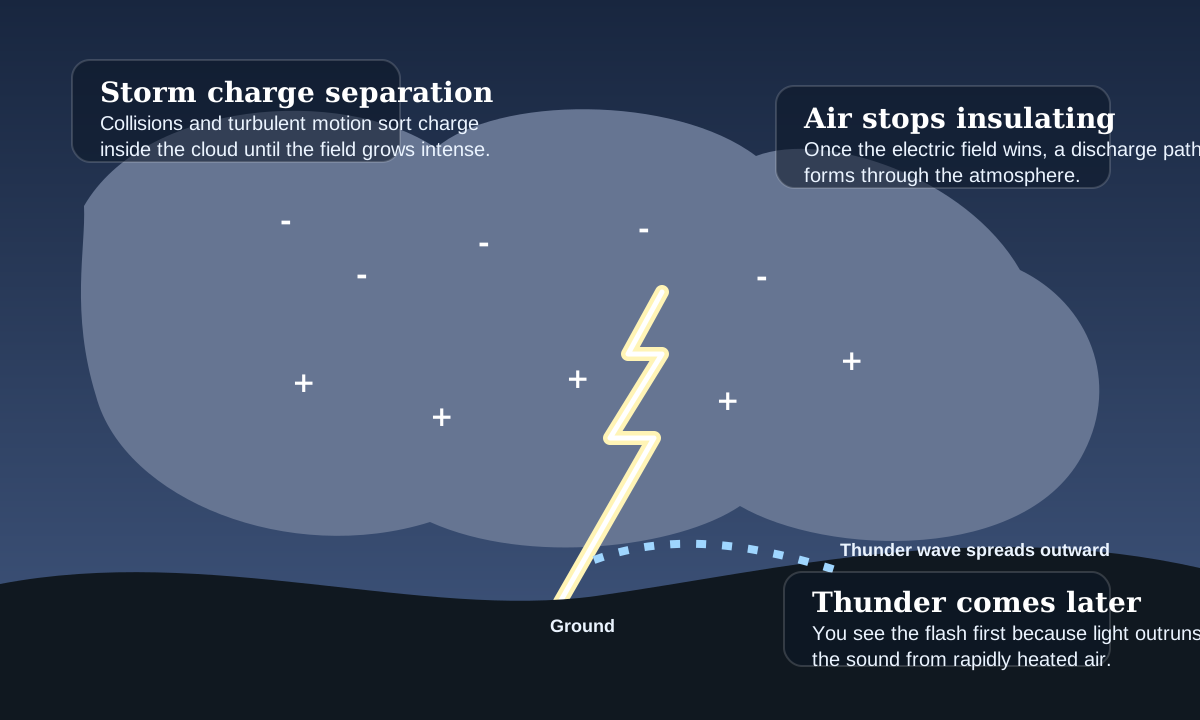
Lightning begins inside storms that are doing charge-separation work. Rising and falling particles, especially ice and graupel, keep colliding and sorting electric charge until the field becomes strong enough to punch a conductive path through the air.
Lightning is a giant electrical discharge that happens after a storm separates enough charge to overcome the insulating power of air.
Strong updrafts, lots of moisture, and intense ice collisions help build the electric imbalance that makes lightning more likely.
You see the flash almost instantly because light is so fast. Thunder takes longer because sound moves much more slowly through air.
Short Answer
Short answer: What causes lightning?
Lightning happens when a storm separates enough electric charge that the insulating power of air breaks down and a giant electrical discharge races through the atmosphere.
The sections below unpack the main mechanism, the conditions that change the answer, and the follow-up questions readers usually ask next.
Closest next questions: what causes hail?, what causes fog?, how do hurricanes form?
Short answer
Storms build charge separation until air can no longer hold the electric imbalance back.
Why thunder lags
Light arrives almost instantly, but the sound wave from rapidly heated air takes longer to reach you.
Why many flashes stay in-cloud
Not every lightning discharge goes to ground. Many flashes jump within or between clouds instead.
Also Asked As
Other ways people ask what causes lightning
This page is meant to catch the close variants, common misconceptions, and next-step versions of the same question without forcing readers back to search.
Closest dedicated pages: what causes hail?, what causes fog?, how do hurricanes form?
Choose The Closest Version
If your real question branches from here, start with the closest next page
This is the fastest way to keep the visit useful. The answer stays on-topic, and the next click stays close to what the reader actually meant.
A hail lab that lets you change updraft strength, supercooled water, the freezing layer, and collisions to compare small soft pellets with damaging large hail.
If your question is really about low clouds at ground level What causes fog?A fog lab that lets you change humidity, cooling, wind, and airborne particles to see when clear air crosses the line into a low cloud.
If you want the bigger severe-weather setup How do hurricanes form?A hurricane lab that lets you tune ocean heat, moisture, spin, and wind shear to see when a tropical cluster stays messy or becomes a powerful storm.
If you mean what causes tornadoes? What causes tornadoes?A tornado lab that lets you change instability, wind shear, storm rotation, and moisture to see when a supercell begins focusing spin toward the ground.
Why Trust This Answer
Why trust what causes lightning
This sits near the top on purpose so readers can see how the page was reviewed before they decide whether to keep going.
Review summary
How this page was checked
Reviewed against the listed NOAA and National Weather Service references for the charge-separation, discharge, and thunder explanations on this page.
Key sources
The first places to check behind this answer
Keep The Question Moving
The next questions readers usually ask from here
This keeps the visit useful instead of one-and-done. You can branch into the next natural follow-up or open the closest dedicated explainer without losing the thread.
Yes. A storm can discharge into areas beyond where the heaviest rain is falling, which is why distant storms can still be dangerous.
Jump to the FAQNo. Many flashes stay within a cloud or jump between clouds rather than striking the ground.
Jump to the FAQA hurricane lab that lets you tune ocean heat, moisture, spin, and wind shear to see when a tropical cluster stays messy or becomes a powerful storm.
Open explainerA tornado lab that lets you change instability, wind shear, storm rotation, and moisture to see when a supercell begins focusing spin toward the ground.
Open explainerMyth Check
Does lightning only strike the tallest object around?
Tall objects often help because they can improve the path to ground, but they are not magical guarantees or the whole explanation. The storm first has to build and release enough charge.
Storm charging is the main story
Without a strong electric imbalance in the storm, there is no bolt to guide anywhere. The tall object question matters only after the cloud has already become electrically dangerous.
Paths are about opportunity, not destiny
Tall isolated objects often provide a favorable route, but lightning can strike lower objects, open ground, or jump unexpectedly depending on the evolving electric field.
Try It Yourself
Lightning Lab
Boost the storm updraft, add moisture, intensify ice collisions, or improve the path toward the ground to see when a quiet cloud starts throwing bright discharges.
Move the controls or load a preset to see how the system responds.
What changes the fastest
What is driving the result
The Big Idea
What causes lightning
Learn what causes lightning, how storms separate charge, why bolts branch, and why thunder comes after the flash. Interactive lab, diagram, and FAQs.
Storms loft water and ice upward
Strong convection keeps particles moving through different temperature zones of the cloud, which is essential for charge sorting.
Collisions separate positive and negative charge
As ice crystals, droplets, and graupel collide, charge is transferred and different parts of the storm begin holding different electric signs.
The electric field intensifies
Once the imbalance becomes strong enough, the insulating ability of air starts to fail and a conductive path can form.
A discharge races through the path
The flash equalizes some of the imbalance in a violent burst of current, and the heated air expands so quickly that it generates thunder.
Follow-Up Answer
Why do you see lightning before you hear thunder?
The flash and the sound come from the same event, but they do not travel to you at the same speed.
Light wins the race
The flash reaches your eyes almost immediately across everyday storm distances, so visually the discharge feels instantaneous.
Thunder is a slower pressure wave
The air expands explosively when the bolt heats it, creating a sound wave that crawls outward far more slowly than the light. That is why counting the delay gives a rough sense of distance.
Good Follow-Up Questions
What causes lightning: edge cases and follow-up questions
The short answer helps, but the edge cases, tradeoffs, and scene changes are what usually make the topic memorable.
Most lightning stays inside the cloud
Cloud-to-ground bolts get attention, but many flashes never strike the ground at all. They jump within or between clouds instead.
The bolt you notice is only part of the story
The visible return stroke is dramatic, but it follows a path that was prepared by earlier stepped leaders and branching charge movement.
Thunder is a pressure wave from heated air
Lightning can heat the air so rapidly that it expands explosively, producing the shock-like sound wave we hear as thunder.
Compare Scenes
Why one storm flickers mostly inside the cloud while another starts throwing ground strikes
Storm structure, charge separation, and the available discharge path all shape how the lightning presents itself.
Classic lightning maker
Muggy afternoon thunderstorm
Warm moist air and strong lift can build a tall storm with plenty of charge separation and frequent flashes.
Summer storm
Muggy afternoon thunderstorm
Warm moist air and strong lift can build a tall storm with plenty of charge separation and frequent flashes.
Cloud flash
Mostly intracloud lightning
Some storms separate charge efficiently but do not produce as many cloud-to-ground paths, so the sky flickers within the cloud body itself.
Weak shower
Underpowered rain shower
Without strong lift and enough internal mixing, the electric field never gets dramatic enough to produce much lightning.
Severe storm
Severe rotating storm
Highly organized severe storms can separate charge aggressively and produce frequent, intense lightning and louder thunder.
Fast Answers
What causes lightning? FAQ
Good science pages should answer the obvious follow-ups without making the reader hunt for them.
If your real question is closer to what causes hail?, that page covers the narrower version directly.
If your real question is closer to what causes fog?, that page covers the narrower version directly.
If your real question is closer to how do hurricanes form?, that page covers the narrower version directly.
If your real question is closer to what causes tornadoes?, that page covers the narrower version directly.
Trust And Further Reading
Sources and review notes for what causes lightning
Reviewed against the listed NOAA and National Weather Service references for the charge-separation, discharge, and thunder explanations on this page. This page also links outward to trusted references and inward to nearby explainers on the same topic path.
Editorial review
How this page was reviewed
Reviewed against the listed NOAA and National Weather Service references for the charge-separation, discharge, and thunder explanations on this page.
Further reading
Trusted places to continue learning
Stay In This Topic
More from Storms and Atmosphere
Wind, lightning, hail, hurricanes, fog, and cloud physics explaining when the atmosphere becomes dramatic.
A hurricane lab that lets you tune ocean heat, moisture, spin, and wind shear to see when a tropical cluster stays messy or becomes a powerful storm.
Storms and Atmosphere What causes tornadoes?A tornado lab that lets you change instability, wind shear, storm rotation, and moisture to see when a supercell begins focusing spin toward the ground.
Storms and Atmosphere What causes fog?A fog lab that lets you change humidity, cooling, wind, and airborne particles to see when clear air crosses the line into a low cloud.
Storms and Atmosphere What is the greenhouse effect?A climate-balance lab that lets you tune sunlight, greenhouse gases, cloud cover, and reflectivity to see how much heat the surface keeps versus sends back to space.
Related Public Questions
Questions people on the site are also asking
This keeps the explainer connected to the rest of the archive instead of feeling like an isolated page.
No close public question matches are cached yet, but the search page is a good next stop if you want to explore the archive from this starting point.