Page Guide
Start with the short answer, then follow the mechanism
A sonic boom happens when an object moves faster than pressure disturbances can travel through air, forcing those disturbances into a shock front that sweeps over listeners as a boom.
This cluster is about patterns that look dramatic at human scale but still reduce to force, motion, and energy bookkeeping.
Interactive Explainer
What causes a sonic boom?
A sonic boom happens when an object moves faster than pressure disturbances can travel through the surrounding air. Instead of gentle waves spreading ahead of the object, the waves pile up into a shock front that sweeps over listeners as a sharp boom.
A sonic boom is the sound of stacked-up shock waves created when an object outruns the speed at which pressure information moves through air.
The boom is not just the moment an aircraft first exceeds Mach 1. It continues as a moving shock cone while the aircraft remains supersonic.
A boom produced high above the ground spreads and weakens differently from one produced lower down, so the surface experience can change a lot.
Short Answer
Short answer: What causes a sonic boom?
A sonic boom happens when an object moves faster than pressure disturbances can travel through air, forcing those disturbances into a shock front that sweeps over listeners as a boom.
The sections below unpack the main mechanism, the conditions that change the answer, and the follow-up questions readers usually ask next.
Closest next questions: how do airplanes fly?, why do planets orbit the sun?, what causes lightning?
Short answer
A sonic boom is a shock-wave problem, not just a loud-engine problem.
Why it is not a one-time event
The boom travels with the moving shock cone as long as the object stays supersonic.
Why some booms feel different
Altitude, aircraft shape, maneuvers, and the atmosphere all change how the shock arrives at the ground.
Also Asked As
Other ways people ask what causes a sonic boom
This page is meant to catch the close variants, common misconceptions, and next-step versions of the same question without forcing readers back to search.
Closest dedicated pages: how do airplanes fly?, why do planets orbit the sun?, what causes lightning?
Choose The Closest Version
If your real question branches from here, start with the closest next page
This is the fastest way to keep the visit useful. The answer stays on-topic, and the next click stays close to what the reader actually meant.
A flight lab that lets you change airspeed, wing angle, air density, and wing shape to see when lift beats drag and when the wing runs out of margin.
If you want a force-and-motion answer from space scale Why do planets orbit the Sun?An orbit lab that lets you change solar gravity, sideways speed, distance, and orbital nudges to compare stable paths with inward falls and escape-leaning trajectories.
If you mean what causes lightning? What causes lightning?A lightning lab that lets you combine updrafts, moisture, ice collisions, and ground connection to see when a storm charges up and finally discharges.
If you mean why do magnets attract? Why do magnets attract?A magnet lab that lets you vary field strength, distance, material response, and pole setup to compare strong pull, weak response, and outright repulsion.
Why Trust This Answer
Why trust what causes a sonic boom
This sits near the top on purpose so readers can see how the page was reviewed before they decide whether to keep going.
Review summary
How this page was checked
Reviewed against the listed NASA references for supersonic flight, shock-wave formation, and the way sonic booms change before they reach the ground.
Key sources
The first places to check behind this answer
Keep The Question Moving
The next questions readers usually ask from here
This keeps the visit useful instead of one-and-done. You can branch into the next natural follow-up or open the closest dedicated explainer without losing the thread.
Not automatically. Speed matters, but altitude, air density, and aircraft design also affect the boom that reaches the listener.
Jump to the FAQYes. Atmospheric structure can bend, spread, or focus the shock as it travels.
Jump to the FAQA lightning lab that lets you combine updrafts, moisture, ice collisions, and ground connection to see when a storm charges up and finally discharges.
Open explainerA magnet lab that lets you vary field strength, distance, material response, and pole setup to compare strong pull, weak response, and outright repulsion.
Open explainerMyth Check
Is there just one boom when the aircraft breaks the sound barrier?
No. The crack at the ground comes from a moving shock cone, so new listeners keep hearing the boom as that cone keeps sweeping along with the aircraft.
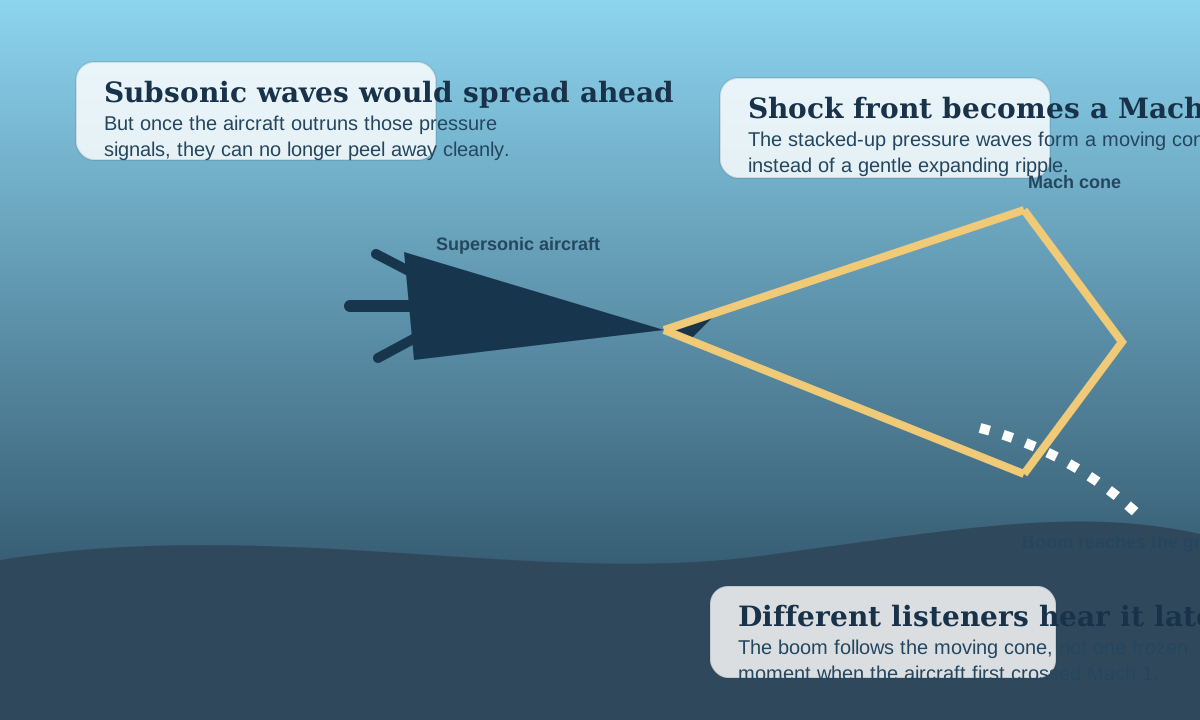
The boom reaches people at different times
Observers hear the shock when the cone reaches their location, which is why people far apart along the flight path can hear the boom at different moments.
Mach 1 is the threshold, not the whole story
Crossing the sound speed matters because it creates the shock cone, but the cone persists and evolves with the aircraft instead of vanishing after one dramatic instant.
Try It Yourself
Sonic Boom Lab
Push the object beyond the sound speed, raise or lower its altitude, thicken the air, or tighten the maneuver to see how the shock cone sharpens and how the ground boom changes.
Move the controls or load a preset to see how the system responds.
What changes the fastest
What is driving the result
The Big Idea
What causes a sonic boom
Learn what causes a sonic boom, why it is not just one instant at Mach 1, and why some passes sound softer or like a double boom.
Moving objects create pressure disturbances
Any aircraft or projectile pushes on the air and sends out sound-like pressure waves as it moves.
Subsonic motion lets the waves spread ahead
Below the sound speed, those disturbances outrun the object and do not pile up into a single intense front.
Supersonic motion stacks the waves into a shock
Once the object moves faster than the pressure disturbances can get away, the waves compress into a cone-shaped shock structure.
The boom happens when the cone reaches you
An observer hears the sharp boom when that shock front sweeps over their position, not just when the aircraft first crossed Mach 1 elsewhere.
Follow-Up Answer
Why can one sonic boom sound softer, sharper, or even like a double boom?
The shock structure changes on its way to you, and different parts of the aircraft can contribute different pressure jumps.
Different shock signatures can stack into a double boom
Aircraft shape matters. Pressure changes from the nose, body, and tail can arrive as distinct features in the final waveform instead of one perfectly simple crack.
Altitude and weather reshape the ground hit
The farther the shock travels through the atmosphere, the more opportunities there are for spreading, bending, or focusing that change what listeners experience at the surface.
Good Follow-Up Questions
What causes a sonic boom: edge cases and follow-up questions
The short answer helps, but the edge cases, tradeoffs, and scene changes are what usually make the topic memorable.
The cone angle changes with speed
Faster supersonic motion produces a narrower cone because the object outruns its pressure signals by a larger margin.
Boom strength depends on more than speed alone
Altitude, air density, aircraft shape, and flight path all affect how strong the shock is by the time it reaches the ground.
You can outrun sound, not all information
The key is outrunning pressure communication through the local medium. That is what forces the air response into a shock front.
Compare Scenes
Why one pass is just loud aircraft noise while another delivers a chest-thumping boom
Supersonic speed is the gateway, but shock intensity at the ground depends on altitude, atmosphere, and flight behavior too.
No shock cone yet
Subsonic aircraft pass
The aircraft still makes noise, but the pressure waves are not stacking into a supersonic shock front.
Subsonic
Subsonic aircraft pass
The aircraft still makes noise, but the pressure waves are not stacking into a supersonic shock front.
Just supersonic
Near-threshold supersonic pass
Just beyond Mach 1, the boom appears because the waves are now stacking into a shock cone that reaches the observer.
High altitude
High-altitude supersonic flight
The boom can still exist, but the long trip through thinner air changes how sharply the shock is felt at the surface.
Sharp turn
Aggressive supersonic maneuver
Maneuvers can reshape the pressure pattern and sometimes intensify what parts of the shock structure are delivered to the ground.
Fast Answers
What causes a sonic boom? FAQ
Good science pages should answer the obvious follow-ups without making the reader hunt for them.
If your real question is closer to how do airplanes fly?, that page covers the narrower version directly.
If your real question is closer to why do planets orbit the sun?, that page covers the narrower version directly.
If your real question is closer to what causes lightning?, that page covers the narrower version directly.
If your real question is closer to why do magnets attract?, that page covers the narrower version directly.
Trust And Further Reading
Sources and review notes for what causes a sonic boom
Reviewed against the listed NASA references for supersonic flight, shock-wave formation, and the way sonic booms change before they reach the ground. This page also links outward to trusted references and inward to nearby explainers on the same topic path.
Editorial review
How this page was reviewed
Reviewed against the listed NASA references for supersonic flight, shock-wave formation, and the way sonic booms change before they reach the ground.
Further reading
Trusted places to continue learning
Stay In This Topic
More from Physics and Matter
Airflow, magnetism, orbits, sound, and shock waves showing how forces become visible consequences.
A magnet lab that lets you vary field strength, distance, material response, and pole setup to compare strong pull, weak response, and outright repulsion.
Physics and Matter How do airplanes fly?A flight lab that lets you change airspeed, wing angle, air density, and wing shape to see when lift beats drag and when the wing runs out of margin.
Physics and Matter Why does metal rust?A corrosion lab that lets you change moisture, oxygen, salt, and coating damage to see when iron stays stable and when it begins to crumble into rust.
Physics and Matter Why do bubbles form spheres?A bubble lab that lets you adjust soap mix, inflation, airflow, and crowding to see when a bubble stays round and when foam geometry takes over.
Related Public Questions
Questions people on the site are also asking
This keeps the explainer connected to the rest of the archive instead of feeling like an isolated page.
No close public question matches are cached yet, but the search page is a good next stop if you want to explore the archive from this starting point.