Page Guide
Start with the short answer, then follow the mechanism
Airplanes fly because wings moving through air create lift while engines or stored speed keep the aircraft moving forward against drag, and the wing has to stay below the angle where the airflow breaks down into a stall.
This cluster is about patterns that look dramatic at human scale but still reduce to force, motion, and energy bookkeeping.
Interactive Explainer
How do airplanes fly?
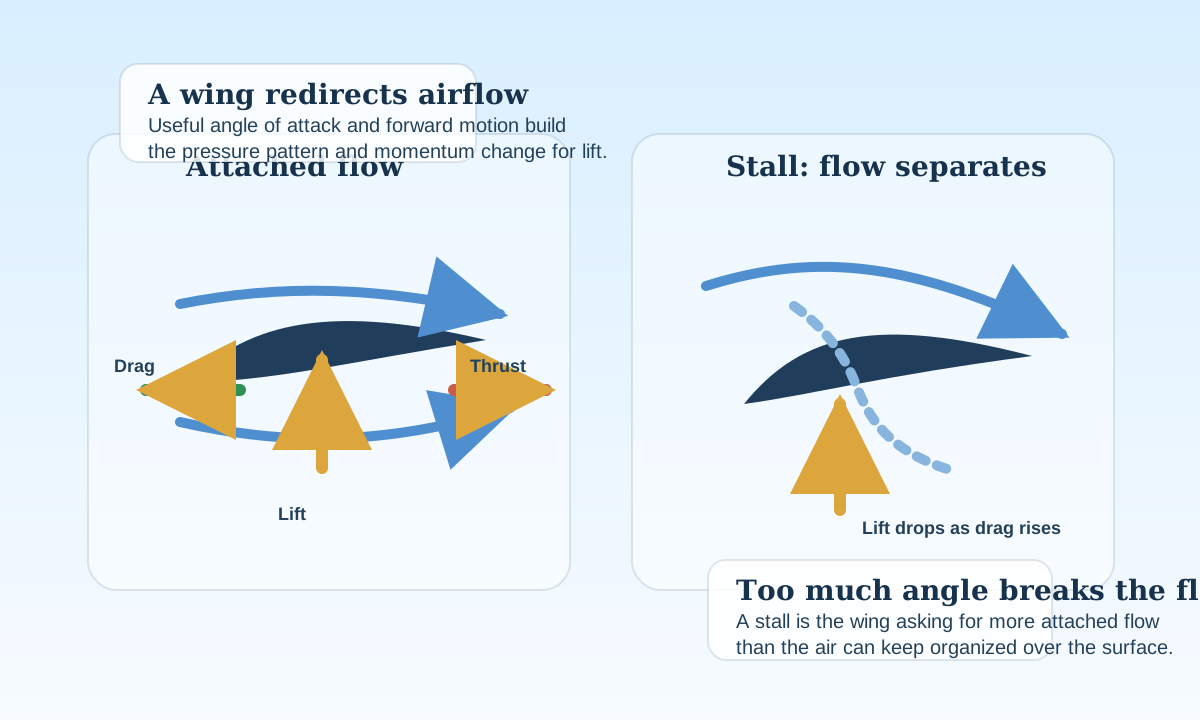
Airplanes fly because wings moving through air generate lift while engines or stored speed keep the aircraft moving forward against drag. The wing has to meet the air at a useful angle, but not such an extreme angle that the smooth flow breaks down and the wing stalls.
A wing flying forward redirects air and creates a pressure pattern that produces lift. If lift is large enough relative to weight and drag, the airplane stays up or climbs.
Faster airflow over the wing usually increases lift potential, which is why takeoff and climb require enough airspeed before the airplane can support its weight comfortably.
Increasing wing angle can help lift only up to a point. Push it too far and the airflow separates, lift collapses, and drag surges in a stall.
Short Answer
Short answer: How do airplanes fly?
Airplanes fly because wings moving through air create lift while engines or stored speed keep the aircraft moving forward against drag, and the wing has to stay below the angle where the airflow breaks down into a stall.
The sections below unpack the main mechanism, the conditions that change the answer, and the follow-up questions readers usually ask next.
Closest next questions: what causes a sonic boom?, why do planets orbit the sun?, how does a compass work?
Short answer
A wing creates lift by shaping and redirecting airflow as it moves forward through the air.
Why speed matters
A wing needs enough airflow to support the airplane’s weight with useful margin.
Why too much angle fails
Lift grows only up to a point. Past a critical angle, the flow separates and the wing stalls.
Also Asked As
Other ways people ask how do airplanes fly
This page is meant to catch the close variants, common misconceptions, and next-step versions of the same question without forcing readers back to search.
Closest dedicated pages: what causes a sonic boom?, why do planets orbit the sun?, how does a compass work?
Choose The Closest Version
If your real question branches from here, start with the closest next page
This is the fastest way to keep the visit useful. The answer stays on-topic, and the next click stays close to what the reader actually meant.
A sonic-boom lab that lets you push speed past Mach 1, change altitude, thicken the air, and sharpen maneuvers to compare shock strength and ground impact.
If you want a force-and-motion answer from space scale Why do planets orbit the Sun?An orbit lab that lets you change solar gravity, sideways speed, distance, and orbital nudges to compare stable paths with inward falls and escape-leaning trajectories.
If you mean how does a compass work? How does a compass work?A compass lab that lets you tune field strength, interference, latitude, and needle friction to see when the needle locks on and when it starts lying to you.
If you mean what causes lightning? What causes lightning?A lightning lab that lets you combine updrafts, moisture, ice collisions, and ground connection to see when a storm charges up and finally discharges.
Why Trust This Answer
Why trust how do airplanes fly
This sits near the top on purpose so readers can see how the page was reviewed before they decide whether to keep going.
Review summary
How this page was checked
Reviewed against the listed NASA and FAA references for the lift, drag, airflow, and stall explanations used on this page.
Key sources
The first places to check behind this answer
Keep The Question Moving
The next questions readers usually ask from here
This keeps the visit useful instead of one-and-done. You can branch into the next natural follow-up or open the closest dedicated explainer without losing the thread.
A stall is the breakdown of smooth airflow over the wing after the angle of attack becomes too high, causing lift to drop and drag to increase sharply.
Jump to the FAQBecause while they help lift at low speeds, they also add drag and reduce cruise efficiency.
Jump to the FAQA sonic-boom lab that lets you push speed past Mach 1, change altitude, thicken the air, and sharpen maneuvers to compare shock strength and ground impact.
Open explainerA compass lab that lets you tune field strength, interference, latitude, and needle friction to see when the needle locks on and when it starts lying to you.
Open explainerMyth Check
Is airplane lift explained by “faster air over the top” and nothing else?
That slogan points toward part of the pressure story, but by itself it is too thin. Real lift is about the wing, the angle, the pressure field, and the way the airflow is redirected together.
There is no single magic sentence
A wing works because it meets the airflow at a useful shape and angle, building a pressure pattern while also redirecting air. Trying to explain flight with one isolated slogan usually hides more than it reveals.
The balance matters as much as lift itself
The airplane still has to pay for drag, stay below stall, and generate enough forward speed. Flying is a stable balance among several forces, not a one-force trick.
Try It Yourself
Flight Lab
Accelerate the aircraft, rotate the wing, thin the air, or change the wing shape to see when takeoff becomes easy, cruise becomes efficient, or the wing drifts toward stall.
Move the controls or load a preset to see how the system responds.
What changes the fastest
What is driving the result
The Big Idea
How do airplanes fly
Learn how wings create lift, why speed and angle matter, and what a stall really means. Interactive lab, diagram, and FAQs.
The wing has to move through air
No forward motion means no useful aerodynamic lift. A wing needs airflow to build the pressure differences and momentum changes that support the airplane.
Wing shape and angle steer the air
A curved wing or deployed flap can increase lift, and a moderate angle of attack can strengthen it further by redirecting airflow more aggressively.
Drag grows alongside lift
More angle and more lift usually come with more drag, so engines or stored speed must keep paying the aerodynamic bill.
Stall happens when the wing asks too much of the airflow
Past a critical angle, the air can no longer follow the wing smoothly. Lift drops and drag rises, which is why “more nose-up” is not always “more flying.”
Follow-Up Answer
What does a stall actually mean?
A stall is not just “the plane got too slow.” It is the wing asking more of the airflow than the airflow can stay attached to.
The real trigger is angle of attack
Low speed makes a stall easier to reach because the wing needs a higher angle to produce enough lift, but the aerodynamic trigger is the wing exceeding its critical angle of attack.
That is why more nose-up can make things worse
Past the critical angle, lift drops and drag surges. Pulling harder without the right recovery just asks the separated flow to do something it can no longer do.
Good Follow-Up Questions
How do airplanes fly: edge cases and follow-up questions
The short answer helps, but the edge cases, tradeoffs, and scene changes are what usually make the topic memorable.
Dense air helps pilots
A wing in denser air can generate the same lift at lower true speed than it can in very thin high-altitude air.
Flaps trade efficiency for extra low-speed lift
They help on takeoff and landing because they let the wing produce more lift at lower speeds, but they also increase drag so they are not ideal for fast cruise.
A stall is about angle, not just low speed
Low speed makes a stall easier to reach, but the real aerodynamic trigger is the wing exceeding a critical angle of attack.
Compare Scenes
Why one setup climbs cleanly while another mushes toward stall
The same wing can feel powerful or fragile depending on its speed, angle, the density of the air, and how aggressively it is configured.
Lift-boosted and accelerating
Runway rotation
With plenty of dense air and a lift-boosted wing, a moderate angle quickly creates the margin needed to leave the runway.
Takeoff
Runway rotation
With plenty of dense air and a lift-boosted wing, a moderate angle quickly creates the margin needed to leave the runway.
Cruise
Clean-wing cruise
The airplane is moving fast enough that it does not need a dramatic angle or heavy flap setting to hold altitude efficiently.
Near stall
Slow steep wing
The pilot is asking the wing for more lift than the airflow can support smoothly, so the margin evaporates and drag surges.
Thin air
High-altitude thin atmosphere
The wing still works, but lower air density means it has to move faster or use more angle to make the same lift.
Fast Answers
How do airplanes fly? FAQ
Good science pages should answer the obvious follow-ups without making the reader hunt for them.
If your real question is closer to what causes a sonic boom?, that page covers the narrower version directly.
If your real question is closer to why do planets orbit the sun?, that page covers the narrower version directly.
If your real question is closer to how does a compass work?, that page covers the narrower version directly.
If your real question is closer to what causes lightning?, that page covers the narrower version directly.
Trust And Further Reading
Sources and review notes for how do airplanes fly
Reviewed against the listed NASA and FAA references for the lift, drag, airflow, and stall explanations used on this page. This page also links outward to trusted references and inward to nearby explainers on the same topic path.
Editorial review
How this page was reviewed
Reviewed against the listed NASA and FAA references for the lift, drag, airflow, and stall explanations used on this page.
Further reading
Trusted places to continue learning
Stay In This Topic
More from Physics and Matter
Airflow, magnetism, orbits, sound, and shock waves showing how forces become visible consequences.
A corrosion lab that lets you change moisture, oxygen, salt, and coating damage to see when iron stays stable and when it begins to crumble into rust.
Physics and Matter Why do bubbles form spheres?A bubble lab that lets you adjust soap mix, inflation, airflow, and crowding to see when a bubble stays round and when foam geometry takes over.
Physics and Matter What causes a sonic boom?A sonic-boom lab that lets you push speed past Mach 1, change altitude, thicken the air, and sharpen maneuvers to compare shock strength and ground impact.
Physics and Matter How does a compass work?A compass lab that lets you tune field strength, interference, latitude, and needle friction to see when the needle locks on and when it starts lying to you.
Related Public Questions
Questions people on the site are also asking
This keeps the explainer connected to the rest of the archive instead of feeling like an isolated page.
No close public question matches are cached yet, but the search page is a good next stop if you want to explore the archive from this starting point.